

The Nuragic civilisation emerged and developed throughout Sardinia during the Middle and Late Bronze Age and the Iron Age (c. 1700–700 BC).
The History and Origins of Sardinian Civilisation
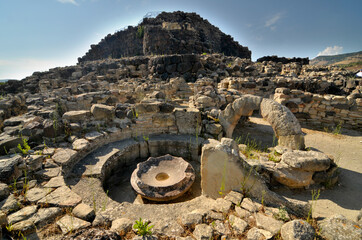
Nuraxi in Barumini
In ancient times, Greek geographers and historians attempted to solve the enigma of the mysterious peoples who built the nuraghi. To them, Sardinia was the largest island in the Mediterranean (in reality, it is the second largest) and they described it as a happy and free land, where a rich and refined civilisation flourished alongside a highly prosperous agricultural sector.
Read the reviews and book your visit here
It was the result of the gradual evolution of pre-existing cultures that had already been present on the island since the Neolithic period, the most obvious traces of which that have survived to the present day consist of dolmen, menhir e domus de janas, to which were added the new cultural influences and contributions of the Metal Age. It owes its name to the Nuraghi, imposing megalithic structures regarded as its most eloquent remains, the actual function of which has been the subject of debate for at least five centuries.
Domus de Janas

Throughout its millennia-long history, it maintained continuous cultural and commercial exchanges with the most important contemporary Mediterranean civilisations, until, during the 6th century BC, its conflict first with Carthaginian imperialism and then with Roman imperialism sealed its decline. It survived in the central-eastern part, known as Barbagia, at least until the 2nd century AD, by which time it was in the Imperial era. and, according to some scholars, even as late as the early Middle Ages, which is why Christianity is thought to have taken hold only later in these independent Nuragic communities.
Sardinian Culture in the Past
In the past, the ancient Sardinians built numerous sacred wells, various monuments and even what we call nuraghi, guided by animist beliefs – that is, the worship of various kinds of gods – or by an astronomical understanding of water.
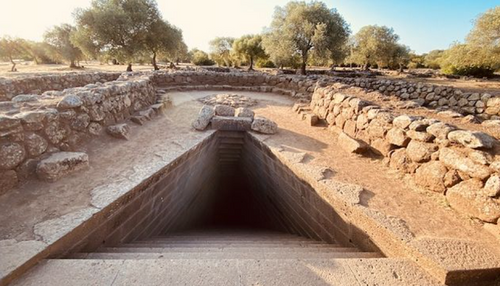
The heart of the spring temple is the hall with a tholos vault – as in the nuraghi – which is usually underground and where the spring water was collected. A staircase connected the chamber to the temple’s atrium, which was generally situated at the level of the surrounding ground and surrounded by small stone altars on which offerings were placed and on which the rites associated with the worship of sacred water were performed. The sacred wells underwent changes over time. Built over water sources, they were places of pilgrimage, and a sanctuary-village would generally develop around them.
Funeral Architecture
The giants’ tombs In their largely unexplored structural and technical diversity, they bear witness to the complex evolution of Nuragic civilisation right up to the dawn of the Iron Age. These megalithic funerary structures, whose ground plan may represent the head of a bull, are distributed evenly across the island, although there is a very high concentration in its central part. They are collective tombs consisting of an elongated burial chamber, constructed from stone slabs set vertically and covered with slabs
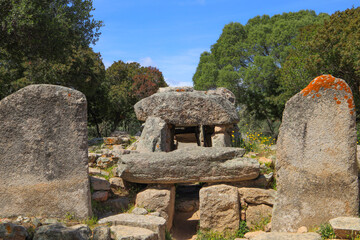
Obelisks often stood near the tombs, undoubtedly symbolising the gods or ancestors who watched over the dead. These menhir-like structures are called baity-loi (betili in Italian), a word that appears to derive from beth-el, which in Hebrew means “house of God”.
Sardinian Costumes
From the oldest to the most modern Sardinian costumes, each one embodies ancient traditions.
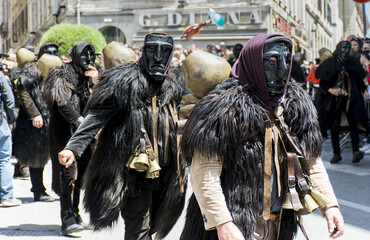
Sardinian Mamuthones
The origins of the Mamuthones remain a matter of debate to this day. According to one study, “there are no written sources attesting to the presence of the Mamuthones in ancient times (bearing in mind that the transmission of customs and traditions in Sardinia is purely oral).’ Oral accounts confirm that the Mamuthones were already parading as early as the 19th century. Some, however, maintain that the ritual dates back to the Nuragic age, as an act of veneration for animals, to protect against evil spirits or to ensure a good harvest. Among the hypotheses put forward regarding the origin of the ritual are a celebration of the victory of the Barbagia shepherds over the Saracen invaders, or a ritual procession carried out by the Nuragic people in honour of some agricultural and pastoral deity. Some scholars argue that there is a link with Dionysian rites, whilst others reject this connection and instead regard it as one of the rites marking the changing of the seasons.
Nowadays, these masks are often used in carnival parades, particularly in Barbagia (central Sardinia).
Traditional Sardinian Costumes for Men and Women
Among the things that most characterise Sardinian tradition are undoubtedly the traditional costumes, which in Sardinia are truly numerous, colourful and vary from village to village. Sardinian women’s costumes are generally very colourful, with red and purple enhancing feminine elegance. Men’s Sardinian costumes, on the other hand, are more understated, usually black and white, though they too can sometimes feature rich colours, typically blue and red.
Traditional Sardinian clothing is skilfully crafted by artisans who have kept the Sardinian textile tradition alive for centuries. Sardinian costumes and garments are often complemented by pieces of traditional Sardinian jewellery.
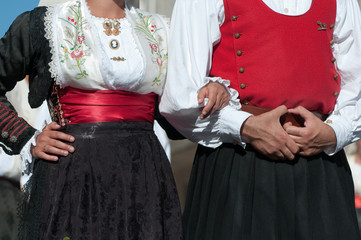
Rather than “costumes”, we should speak of traditional Sardinian dress when referring to the typical clothing that Sardinians used to wear in the past. It consisted of a number of recurring elements in the common ‘island fashion’ that were worn throughout Sardinia by the majority of the population.



 Italian
  English